|
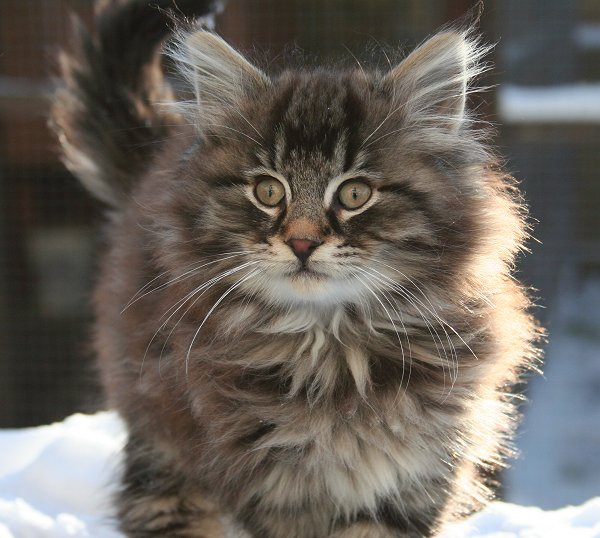
Advice and awareness regarding buying kittens.
This article covers, breeders, kittens, and myths!
First and foremost there are very important considerations to buying a Norwegian Forest Cat. These are regarding the welfare of the cat.
In the original Norwegian literature it states " no matter how well provided for a Forest Cat is - if it has a mind to go it will go".
These cats are very bold - courageous and fearless. They are formidable hunters and will claim a much wider territory than any other breed of cat including the domestic moggie.
These cats are very majestic and are liable to be stolen. If allowed to free roam they WILL get run over - or lost before the age of 2 years old mostly younger than that. Also another thing to bear in mind is that out in the free living feline world there are stray cats who are not neutered and not vaccinated - they only have to bite another cat and Feline Leukaemia and Feline Aids can be transmitted and there is no cure for either of these awful diseases.
Buying a kitten from us you must be prepared to either keep them as indoor pets which they are quite happy to be providing they have a scratch post/ climbing frame or two - plenty of stimulating toys and most importantly good quality time with their owners. They also benefit highly from having a playmate as well. BUT the best of both worlds is having an outdoor Avery type enclosure with lots of ledges - shelves etc.
_________________________________
A pedigree kitten of
any breed will be an investment both in terms of a new family member
and a lengthy financial commitment.
Like any idea and
action in life there are doubts, suspicions and misconceptions. Yes of
course there are less scrupulous breeders of all breeds and animal
types in the world. We have all met them sometime in our lives. The
fact is most breeders of animals are dedicated, scrupulous, clean
and do have the animals health and welfare uppermost in their minds
and are not money grabbing and exploiting animals for financial
gain, they are classed as "hobby breeders". Any dedicated breeder knows only too well if there is
profits to
be made corners are being cut.
So the next question is how do I know if a breeder is good or not?
-
A good
breeder is one who provides a lifetime commitment to the health and
welfare of their own cats and any kittens they breed.
-
Facilities
for the animals should be clean and not heaving of cat urine, be of
appropriate size comfortable and stimulating.
-
Cats and Kittens should be fed a well balanced diet suitable for
their needs and development at any given time.
-
Cats should be tested for any genetic defect that is common
within their chosen breed.
-
The
breeder should be both knowledgeable in their own breed history,
health, basic physiology and welfare.
-
Equal
to all this, they should love their animals for the companions they
are and not for any financial gain or show reputation.
-
A
breeder should be a friend for life extending advice and support for
the duration of any kittens lifetime.
What
should you expect from a breeder?
-
A
breeder should be Honest, Trustworthy, Reliable, Responsible,
Dedicated and Committed.
What
questions will you be asked?
-
A
breeder should first ascertain if the prospective buyers are the
best people for one of their kittens.
-
Have you owned cats before?
-
The
family circumstances will need to be taken into account to see if
they are suitable to the breed characteristics and each
individual kittens personality and temperament should be matched to
the same.
-
Do
you live in a built up area? If so are you prepared to give the
kitten an indoor life? Will you build a cat run/garden in order for
the cat to have a safe but stimulating life?
-
Are
you committed over the next 10-20 years to the cats welfare and
interests? Are you financially secure enough in the event of the cat
needing veterinary treatment? Are you prepared to insure the cat for
life in case of an illness, accident or emergency that may require
extensive medical treatment?
-
Do
you have other animals? If so what is their temperament like? Does
the breed like the company of other animals in particular its own
species?
-
Do
you work full time? If so are you prepared to have another cat or
kitten as a companion for the kitten? There is never any need
to buy two pedigrees kittens although it is nice to have a sibling,
there are many cats and kittens in rescue centres that need homes
probably more so than a pedigree kitten.
What questions should you ask yourself and your breeder?
-
Why
do I want a Kitten?
-
How
much should you pay for a kitten?
-
Does this price cover vaccines and if so what Vaccines do they have?
and when do they have these?
-
At
what age should a kitten leave for their new home? This should not
be under 13 weeks of age!
-
How
do I introduce a new kitten into a house with other resident
animals?
-
What
criteria does the breeder have for their kittens?
-
What
will you need to provide for your new kitten?
-
What are the best toys to stimulate them?
-
What diet is the kitten used to and what is best for them as they
develop?
-
At
what age is best to have the kitten neutered or spayed?
-
How
often does the kitten/breed need grooming and what are the best
tools for this?
-
Do
you receive a Pedigree and registration for your kitten?
-
Do
you want to show or breed?
-
Does the breeder test for the genetic diseases of GSD4 (Glycogen
Storage Disease) and PK Def ( Pyruvate Kinaise Deficiency ?
-
Does the breeder screen their cats for HCM - Hypertrophic
Cardiomyopathy?.
Visiting a breeder.
The
first and most important criteria is - Not to visit more than one
breeder a day - visiting others can and do spread diseases.
Before visiting a breeder arm yourself with tips and awareness.
You will be paying a lot of money for a pedigree kitten - you need to know they are healthy and of sound temperament and type.
Before you decide on a kitten please visit as many breeders as you can - this not only gives you an informed opinion on what is available
but also what criteria is set for the cats and kittens and their
future welfare and what is right for you.
When
buying a kitten from a breeder you should expect a life-long support line or even better a life-long friendship based on trust and mutual respect. Questions that may appear difficult to
for you to ask should not in any way be difficult to answer.
When visiting other breeders see how they keep their cats and do not be afraid of asking them questions - not only about their cats but about themselves, after all you will be asked plenty of yourself. .
Be very aware of breeders making defamatory comments about another breeder. There is much jealousy around this breed, and it is usually no more than that.
Look for their motives for breeding -
is it financial gain?
Does the premises look clean and like a home where cats are happy and relaxed or a commercial enterprise with cats bored, dull, restricted
shy and temperamental.
Basic checks YOU should carry out yourself
when looking at kittens.
-
Are the kittens eyes, nose and ears clean?
-
Do they have black wax in their ears?
-
Do they scratch themselves or their ears frequently?
-
Are there bottoms clean?
-
Do they have any flea dirt in their coats?
-
Do they have clean healthy mouths and gums?
-
Do they have red sore patches on their tongues?
-
Are they sneezing a lot?
-
Do they cough?
-
Do they have sore eyes?
-
Do they have Diarrhoea?
-
Do their tummies look round and bloated?
-
Do they feel too thin?
-
Feel under their throats for enlarged lymph glands.
-
Are their coats nice and clean and free from knots and tangles?
-
Do they have any fur missing or red sore patches?
-
Question if the kittens have been vaccinated. These are basic vaccinations and they protect your kitten - there have been many clinical trials for all vaccines to ensure their efficacy and safety - if you are investing money in a kitten you should at least have the basics.
-
Do they have their kittens micro - chipped and are they issued with a Veterinary Health Certificate following a final full health examination no more than three days before they leave for their new homes?
-
Are they insured for a minimum of 4 weeks which covers the initial settling in period when they are more prone to illness due to the stress of the move.
These are all basic and essential criteria and are all these things covered in the asking price?
How are the cats kept
-
Are they kept in one room all the time or do they have access to the whole house?
-
Where is the mother of any kittens? With them or in another room? What condition is she in?
-
Are the adult cats grouped together living in rooms?
If so do these cats have good stimulating surroundings? Any amount of money can be invested in cat equipment but ask yourself, is this for the cats benefit? or just for show?
-
If the breeder has many cats ask to see them all and not just the one you are interested in.
-
When you visit and while you are going through the meeting process with the breeders notice first what the cats are doing -
-
are they relaxed or curled up asleep, playing, running around and ambushing each other or a little wary because you are on their territory -
-
or are they looking like they are in an environment they are not used to being in. Are they slowly and cautiously slinking around the outer perimeters of the room, are they too easily spooked by noises and by each other? probably because they are not too familiar with their surroundings? Investigating things that they should be familiar with?
-
Do you get the feeling that these cats you are seeing have just been let out into this environment for your visit?
-
Young kittens are your best source for information as they give better clues as to how they are kept than the adults do.
-
Do the adult cats have outdoor enclosures and if so are they of good size for them to be able to run and play?

There are also a
few other misconceptions that I am asked about from time to
time.
MYTHS
Some breeders say
they test their kittens/cats for FIP - there is NO available test for this
disease! not in the UK or abroad! Therefore their claims are
meaningless.
Accolades such as
Best breeder , Top breeder, accredited breeder etc etc as
seen on a few websites means they have a large numbers of
kittens/cats they have bred and that regularly attend
shows. As a result of the sheer volume of breeding they have totted up
points to win these awards. It does not mean these
breeders are Veterinary Inspected or approved, or indeed have any more
qualification or credit, or healthier kittens and cats than any
other breeder does.
Some cat organisations have a list of
breeders who pay for the privilege of having a so called
"accredited cattery", again these clubs do not inspect or
visit these breeders at any time. The Accreditation only means
that the breeders are supposed to abide by
certain recommendations, however, many breeders already have high
standards anyway and do not need to pay for the fact.
Breeders are rich - they make huge profits -
I dare say they can do but I personally do not know of a rich breeder. It is very expensive to breed animals and provide for their needs - however - those that do make profits are cutting corners!
IMPORTANT
NOTICE:
It has come to
the attention of Norwegian Forest
Cat breeders in the UK that kittens are
currently being offered, through magazine
advertisements and the internet pet
for sale and pets 4 homes site in particular ,
to members of the public by some ‘breeders’, at
discounted prices. However these kittens may not be
the bargain they appear to be as some of the kittens
are un-vaccinated, underage and sold without pedigree's.
We would strongly urge all prospective purchasers of
all pedigree kittens to
ensure that their kitten is healthy, at least 13 weeks
of age, has had the full course of vaccinations, comes
complete with a full pedigree and insurance, and has
been bred and cared for by a knowledgeable and
experienced dedicated breeder.
There are also cross breeds of Norwegian Forest Cats ,
this is a definite no no in this breed. Norwegian
Forest cats are not man made breeds they evolved
naturally in Norway. Cross breeding is neither a
forest cat or any other breed - it is a domestic
moggie, and although moggies are certainly lovely they
do not command the prices a pedigree cat does because
the breeding of them is no where near the same. Back
street breeders are doing this to make a quick buck as
they with selling so called pedigree kittens at cheap
prices. They are not paying out for stud fees - for
vaccinations - for parasite treatments and I doubt
they are paying out for good quality veterinary care
and diet. Responsible breeders do not sell kittens to
be bred from by anyone unless they are specifically
sold for that reason. I had a call only last week by
someone who had purchased a so called NFC kitten at 8
weeks of age - sadly the kitten became ill five days
later and died. This is the sort of thing that
frequently happens when kittens are not vaccinated.
Vaccinations are only administered at 9 weeks and 12
weeks of age therefore they should not be sold by
anyone before they have had at least a week after
their vaccinations to recover - hence the 13 weeks old
time for them to go to their new homes.
So please be aware, you could end
up with serious problems.
The changes in the Norwegian Forest Cat.
Changes
to the NFC are already happening in some countries
with the breeds overall look. Selective breeding,
actively encouraged by some Judges and very actively
promoted by some large scale breeders are creating NFC's
with large wide set ears set in a lower "V" shape setting on the
head with overly long heads giving them the appearance of an
Oriental Long Hair. This is NOT what the Norwegian pioneers
of this breed ever wanted - in fact - this breed was
originally given Pedigree status in order to preserve this
naturally evolved cat. However, like all breeds of animals
that are taken to shows - some dogs and cats do not remotely
resemble their original form - one only needs to look at the
Persian and Siamese cats these days to see this - for us as
breeders we will always remain true to the Pioneers and
traditional type Norwegian Forest Cat. We no longer have any
time for the show side of things because we will not be
encouraged or pushed to change the look of this magnificent
cat.
Articles written by L
Twyman is
Copyright
©
Norgeskaukatt
Our Criteria
For information on how we keep our cats and our breeding aims see our breeding page.
Our breeding program is based on the health of our cats first, second and last. We are a "closed" cattery which means we do not accept outside cats in for breeding with ours. This is basics for disease prevention.
We feel it is very important to do a blood chemistry profile on the queens prior to being mated.
This is to ascertain that physiologically she will be in peak condition to carry and produce good strong and healthy kittens.
Many breeders do not cover these tests, they are an important part of keeping cats and their subsequent kittens fit and well. Ill health can be as a result of many things and sadly, not all illnesses show outward symptoms until the problem is well under way - a good example of this is liver / kidney failure and diabetes along with many other disorders.
There are many conditions that can affect felines and apart from the infectious diseases, some illnesses can be regarded as being genetically predisposed or inherited. Having yearly blood profiles taken can alert people that all is not well at a much earlier stage rather than wait for outward symptoms by which time its usually too late!! There are two genetic diseases within the Norwegian Forest Cat - GSD 4 (Glycogen Storage Disease) PK def (
Pyruvate Kinase deficiency). Our cats have been genetic tested for these diseases and are negative.
All of our kittens are fully vaccinated for their core vaccines, micro - chipped and undergo a full program of treatment for ecto and endo parasites. 24 - 48 hours before they leave to go to their new homes our Veterinary surgeon will give the kittens a full health check (equivalent to the exportation examination) then issue a Veterinary health certificate.
An important note regarding the core vaccines for the kittens.
Vaccinations DO NOT prevent the diseases - but are used as core vaccines to prevent the worst of symptoms should they ever become exposed - this can be via contact with other cats or at cat shows - veterinary surgeries etc.
Our kittens are vaccinated using Live Vaccines which is usually Nobivac Tricat . We believe live vaccines induce the better cover should exposure happen. On occasion kittens will have a reaction to their vaccines - this can be at their 9 week or their 12 week or both. This is no fault of the breeder and neither is it an indication of ill health in catteries. It can be compared to humans having their flu jabs - some sail through - other are in bed a week and say never again! Please note: we do not as a matter of course any longer provide the FELV vaccine - it is not a core vaccine- this vaccine carries an adjuvent that contains aluminium and some of the kittens have has nasty reactions to this - our vet recommends that should owners wish to have the FELV vaccine then it is best to wait until they are 6 months old.
The following details are taken from the NOAH Compendium of Animal Health Data sheets for the vaccines which can be found online.
|
Nobivac FeLV |
| Qualitative and quantitative composition Per dose of 1 ml:
Active substance: Minimum quantity of purified p45 FeLV-envelope antigen: 102 µg
Adjuvants: 3 % aluminium hydroxide gel expressed as mg Al: 1 ml
Purified extract of Quillaja saponaria: 10 µg.
Excipient: Buffered isotonic solution to 1 ml.
Indications for use
For active immunisation of healthy cats to prevent persistent feline leukaemia-virus viraemia and any associated clinical signs of the feline leucosis.
The onset of protection begins 2 weeks after immunisation and the duration of protection lasts one year after the primo-vaccination.
Adverse reactions |
Transient and small thickening or nodule, approximately 5 - 10 mm in size, may be observed at the injection site and disappear within 2 to 6 weeks without treatment. Occasionally, systemic reactions (hyperthermia, anorexia, lethargy) may occur within one or two days after vaccine administration.
Where Nobivac FeLV has been used to reconstitute cat vaccines in the Nobivac range containing feline calicivirus (F9 strain), feline rhinotracheitis virus (G2620A strain) and/or feline panleucopenia virus (MW-1 or Bristol strain) prior to inoculation, a small nodule at the site of vaccination is frequently observed. It can persist for up to 18 days post-inoculation. Occasionally, the nodule may be painful for up to 6 days after injection. A transient rise in body temperature or lameness may occur and last up to 3 days post vaccination. In some cases, a slight dullness or reduced appetite may be observed for up to 1 day post vaccination.
In the rare event of hypersensitivity reaction following vaccination, administer an antihistamine, corticosteroid or adrenaline without delay and by the most-immediate route. |
| For further information please visit the website http://www.noahcompendium.co.uk/?id=-455441 |
|
Nobivac Tricat Trio |
| |
| Qualitative and quantitative composition |
Per dose of 1 ml:
Active substances: (lyophilisate) live attenuated feline calicivirus, strain F9 4.6 log10 PFU1
live attenuated feline herpes virus type 1, strain G2620A 5.2 log10 PFU1
live attenuated feline panleucopenia virus, strain MW-1 4.3 log10 CCID502
1PFU: Plaque-Forming Units
2CCID50: Cell Culture Infective Dose 50% |
| Indications for use |
Active immunisation of cats:
- to reduce the clinical signs caused by infection with feline calicivirus (FCV) and feline herpes virus type 1 (FHV),
- to prevent the clinical signs, leucopenia and virus excretion caused by infection with feline panleucopenia virus (FPLV).
Onset of immunity:
for FCV and FHV: 4 weeks; for FPLV: 3 weeks.
Duration of immunity:
for FCV and FHV: 1 year, for FPLV: 3 years. |
| |
| Adverse reactions |
| A slight painful swelling may be observed at the injection site for 1-2 days. A slight transient rise in body temperature (up to 40°C) may occur for 1-2 days. In some cases sneezing, coughing, nasal discharge, and a slight dullness or reduced appetite may be observed for up to 2 days post vaccination. In very rare cases, the vaccine may cause hypersensitivity reactions (pruritus, dyspnoea, vomiting, diarrhoea and collapse). |
Revaccination: A single dose (1 ml) according to the following schedule:
Revaccination against feline calicivirus and feline herpesvirus type 1 must be given every year (with vaccines containing the F9 and G2620 strains). Revaccination against feline panleucopenia virus can be given every three years (with strain MW-1 as in Nobivac Tricat Trio). |
| For further information please visit the website http://www.noahcompendium.co.uk/?id=-455549 |
Temperament of our kittens.
There is no point having a lovely looking cat if you cannot touch it. They all have their own personalities and we concentrate on the importance of good socialisation. This is very important for at least the first 7 weeks of the kittens lives to prevent them from being timid or aggressive they must be handled a great deal from birth and exposed to as many environmental factors as possible.
Our kittens are very affectionate and tactile they socialise and interact very well with people, children and other animals. They are all show trained from a very early age should the new owners wish to show them.
There is nothing worse than taking a beautiful cat to a show that will bite the Judge!
We are told by every one of our kitten owners that our kittens have excellent temperaments and are well socialised - this makes all the hard work so worthwhile. If you require testimonials to this and the health of our kittens please ask us - we have many and we keep a regular health record every 6 months on all the kittens we have bred.
Breeding is a very important decision and we want to do it well and to give our kittens the best start we can.
If you would like information regarding our kittens please contact us by email
or telephone - 01677 470854 - mobile 07718 237079
If you would like to be added to our future kittens list please email us.
Our Kittens do not leave us until they are a minimum of 13 - 14 weeks old.
Our kittens go to their new homes with a kitten contract which is an agreement between us and the new owner that stipulates the above and is formulated for the future welfare of the kitten - and not any financial gain.
Please note: Kitten contracts that stipulate threats of money payable if the contract is broken is not a contract we would ever use - but some breeders do. |